








A children's bicycle has to fit. But there are different ways of stating size. Here you will learn which ones matter and how to determine the right size.
Every beginning is easy — as long as the bicycle suits your child. (–> Tips for buying a first bicycle) Not least, the bike has to be the right size. Seat height and frame height matter most. You can pick up important clues with the naked eye, during a test ride for instance:
- Sitting on the saddle, your child should be able to touch the ground with the balls of both feet at the same time. If that is not possible even with the saddle set low, the bicycle is too large.
- At the same time, the young rider should be able to stand over the frame on both feet (in front of the saddle) without resting on the top tube. Otherwise the frame is too large or too high.
- A bicycle is too small if your child rides with sharply bent legs even at full saddle extension. More on that here: –> Setting saddle height correctly
An oversized frame does harm
Children often fall between two bicycle sizes. The obvious move would be to buy the next size up, on the assumption that the child will grow into it. Like all experts, we strongly advise against this, for three reasons:
- An oversized frame is a safety risk — above all when your child cannot get their feet down quickly enough.
- A frame that is too high makes getting on and off harder.
- A bicycle frame grows not only in height but in length. On a frame that is too long, your child sits too stretched out. That is not only uncomfortable — it also makes the bicycle harder to control and to keep an eye on the road ahead, because both handlebar and brake levers move out of reach in tight corners.
One more thing that should make investing in the right bicycle easier: PUKY bikes have a very long service life and a high resale value. You can pass them on from one child to the next without trouble, or sell them on secondhand for a good price.
As an added bonus, we offer a transferable five-year guarantee on frame, fork and handlebar.
What sizes do children's bicycles come in?
But what if a test ride is not possible? Or if you would rather not rely on your own eye? Then objective figures will help you find the right size.
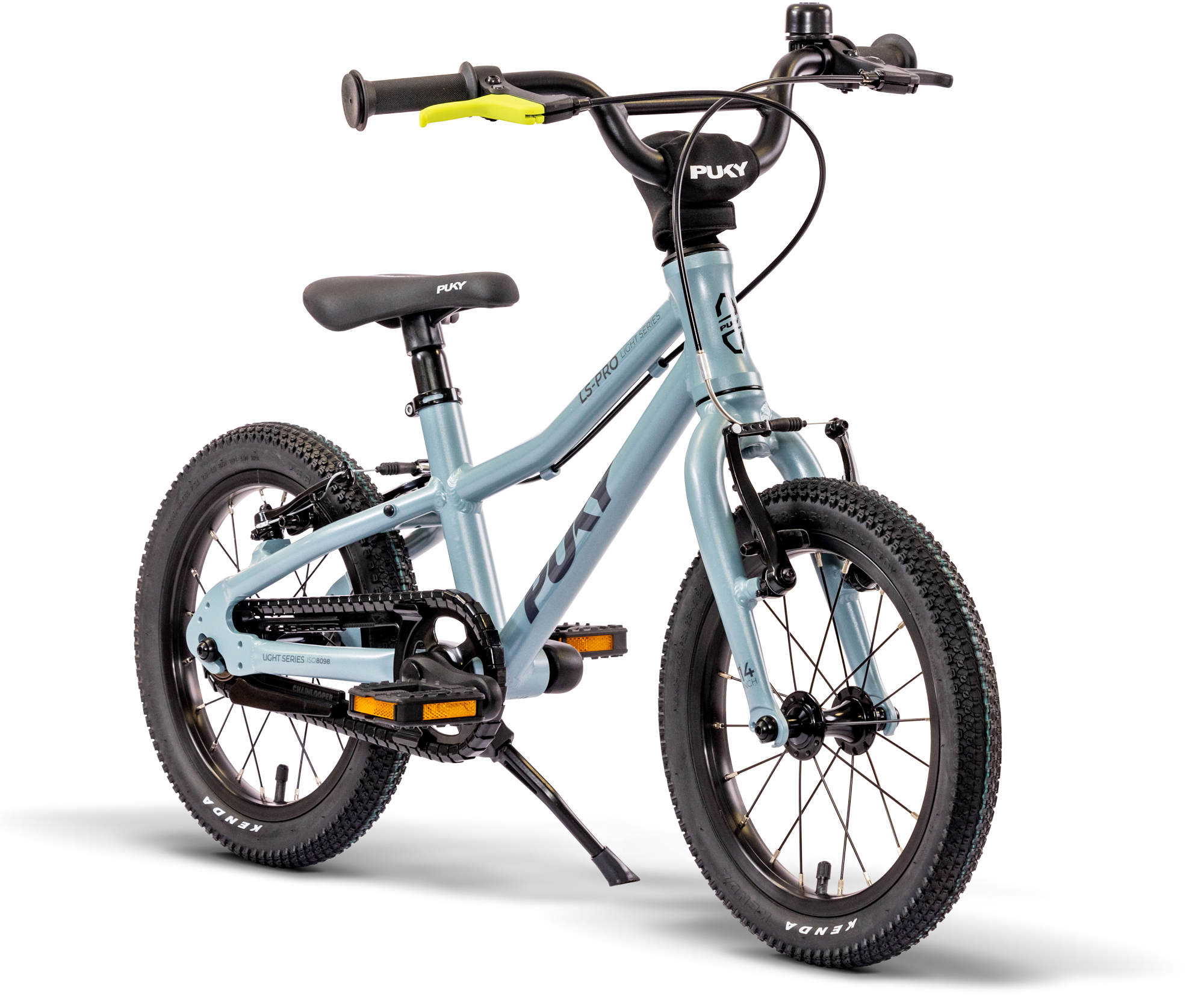
The most common size marking for children's bicycles is the wheel diameter, given in inches (1 inch = 2.54 centimetres). Children's bicycles start at twelve inches and go up in steps of two to 24 inches. The inch figure is a first point of reference in the search for the right bike.
Another common figure is the minimum age for a particular model — „children's bicycle from 3 years" or „age 3+". Children of the same age can be very different in height, however, and it is body size, not date of birth, that has to suit the bicycle. So do pay attention to the recommended body height as well. We list it for every model as „height".
Measuring inside leg length
Children of the same height, in turn, can have legs of different lengths. Inside leg length is ultimately the most important figure for finding the right size of a children's bicycle. That is why we state it separately for every model, as the recommended „step height". (–> How to measure inside leg length)
Because our bicycles have a height-adjustable saddle, the stated range spans around ten centimetres for each model. Within that range, a bicycle can grow with your child. After that, moving up to a larger bike — usually with larger wheels too — is advisable.
In short:
Whether a children's bicycle fits can be judged with an experienced eye. The most important objective figure is your child's inside leg length. It has to match the manufacturer's recommendation for the model.